

Dear Friends,
Today is the official launch of my new book, The Adverse Effects and Therapeutic Potential of Psychedelic Medicines. It is the fourth book in my psychedelics series after Psychedelic Medicine in 2017, Psychedelic Wisdom in 2022, and Psychedelic Medicine at the End of Life in 2024.
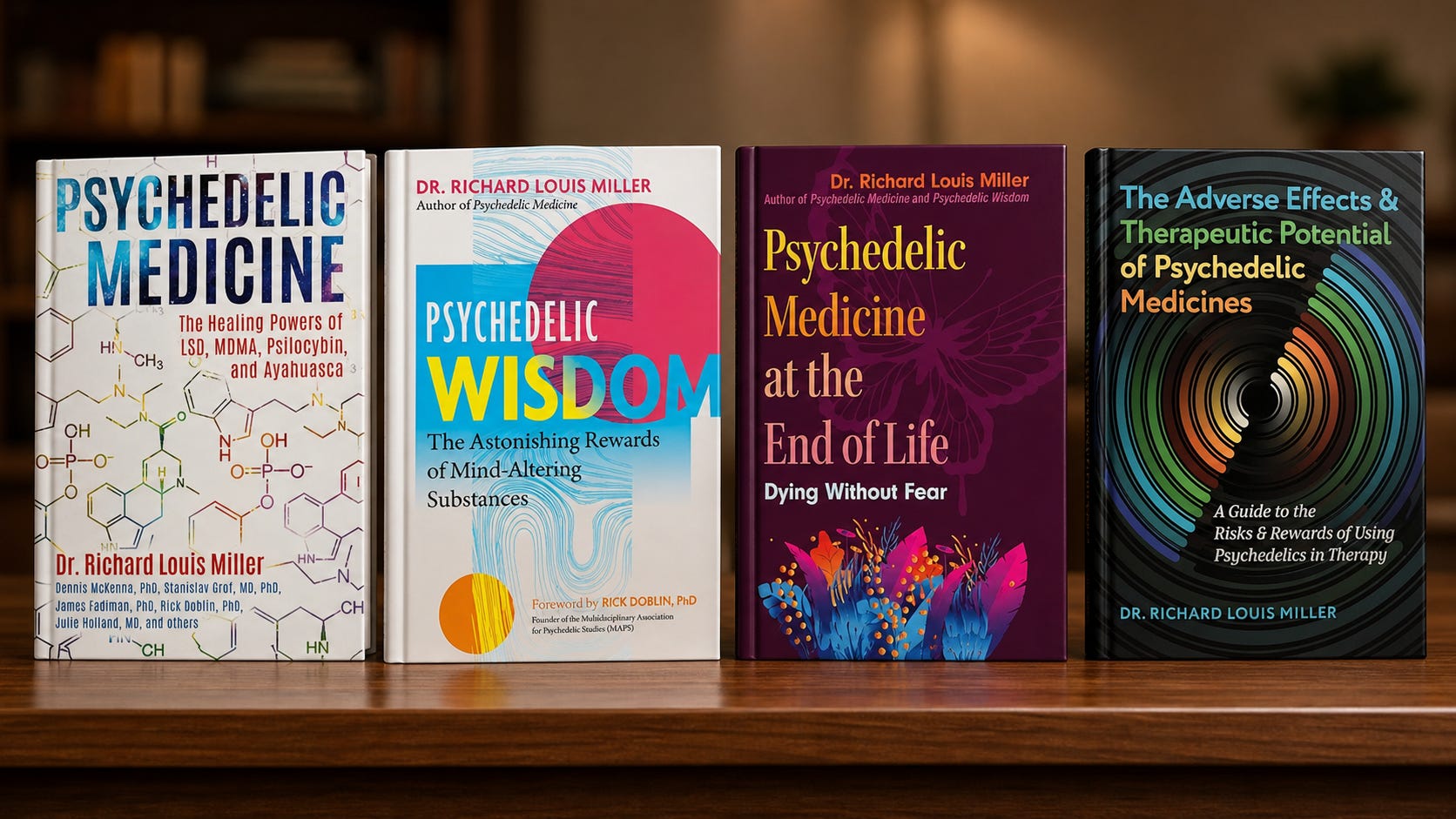
I have been thinking about how to introduce a book to people who already read this newsletter.
You may have already read my commentary on Trump’s recent executive order, and the warning Rick Doblin sent the field a week and a half ago.
You may have been following my internet radio broadcast, where I have been recording the interviews that become the source material for my books.
But you have not seen is the book itself.
So I am going to do something a little different. Instead of telling you what the book is about, I am going to share most of the prologue. The two passages I have left out are personal—one on the criminalization of LSD after 1965 and one on a head-on collision I had with a Winnebago—and they deserve more space than a letter like this one gives them. The full version is in the book.
Before we get to it, I have three requests:
If you have a minute, a 3-question reader survey helps me understand who is reading these letters and what would be most useful to create next.
Subscribe to my podcast to hear my upcoming interview with award-winning journalist Robert Whitaker – launching this Thursday. The pattern he traced with antidepressants is the pattern this book is meant to keep us from repeating.
Lastly, order a copy of Adverse Effects, and if you enjoy it, consider leaving an honest review. I am available for interviews. Email my producer to arrange.
And now, enjoy this excerpt.
Prologue to The Adverse Effects and Therapeutic Potential of Psychedelic Medicines
Many of us in psychedelic science are advocating for certain psychedelic substances to be reclassified as legitimate medicines that both heal and raise consciousness. Therefore, it is essential that we in the psychedelic community—scientists and practitioners—model elevated consciousness through practicing the highest standards of transparency about what is known, what is not known, and what remains uncertain about these substances.
This book focuses on the potential unwanted complications, often called adverse effects, of psychedelic medicines. I use the nomenclature unwanted complications to be precise because adverse effects are typically ascribed to the medicines themselves, whereas unwanted complications take into account the contributions made by factors in addition to the medicine itself, such as the administrator (a.k.a. therapist or guide), the patient’s history, the patient’s mental set at the time of administration, the setting of the administration, the sounds in the environment, and more. An unwanted complication, then, is any harmful, unintended, or undesired reaction to a substance, its administrator, and/or the environment.
Many activities in life bring with them unwanted complications or the potential for such effects. When deciding whether to take any action, we can either make a considered decision weighing the promises and the perils, or we can throw caution to the wind. How much consideration we give each decision typically relates to the potential of serious harm. While we don’t always act sensibly, it makes sense that greater risks call for deeper reflection before taking action.
One of the most severe unwanted complications is death. While most unwanted complications are less severe, they vary in severity from negligible to excruciating. For example, I once took the cardiovascular medicine spironolactone but stopped when it dramatically blistered my lips—the adverse effects outweighed any potential benefit.
My lovely wife, Jolee, is presently undergoing radiation for lobular breast cancer. She is also taking the immunosuppressant letrozole, which suppresses her body’s production of estrogen and progesterone. Both treatments bring unwanted complications including fatigue, loss of appetite, and pain. While some women bypass the treatment because of the severity of the unwanted complications, Jolee has decided that the benefit of the treatment—reduced risk of recurrence—outweighs the unwanted complications.
Anecdotal stories of unwanted complications and adverse effects are common in all cultures—they’re one of the ways that humans learn. Against today’s backdrop of sobering statistics, the data on unwanted complications and adverse effects of all substances require our close attention to make informed decisions.
In 2022, approximately 480,000 people died from the effects of smoking cigarettes and 140,000 died from the adverse effects of alcohol. The toll from pharmaceutical drugs is equally stark: 70,000 deaths from fentanyl, 17,000 from OxyContin, 27,000 from cocaine, and 14,000 from heroin. Contrary to the beliefs of many, deaths from classic psychedelics like LSD, psilocybin, MDMA, and ayahuasca remain vanishingly rare.
This data informs our participation in what has become a worldwide experiment with psychedelic medicines. As research accelerates and personal experimentation grows, we must ask, What are the unwanted complications and adverse effects, the rewards, and the risks?
A significant percentage of the American public has been misled about the relative dangers of psychedelic substances, which has allowed those substances to be kept federally illegal. At the same time, the dangerous mood- and physiology-altering substances—alcohol and cigarettes—are advertised nationally. While we should remain prudently cautious and informed about all new psychoactive compounds, the data suggests our societal fears about them are simply misplaced.
Until we collaborate as a people in placing the value of life above the value of money, we will all suffer from what I call Honest Information Deficit DisEase, or HIDDE (pronounced hiddy). We cannot trust the information we get from cigarette, alcohol, and pharmaceutical companies and even some academic institutions, as profit motives too often, reprehensibly, override public health concerns. In an effort to offer light in these murky waters, I advocate that psychedelic science set the model for radical transparency. This book represents a step toward that goal.
For nearly sixty years, when reflecting on my traditional scientific self-experimentation with psychedelic medicines, I observed growth, expansion, and creativity. These medicines helped me create a life of meaning, love, and little fear. They facilitated my living in a state of chronic gratitude, fostering an endeavor to treat every person I encounter with dignity, respect, kindness, and love. These substantial benefits I have received have led me to lobby for radical transparency and opine that secrets quite often create distance, isolation, anxiety, and depression.
…
I imagine you agree that the decision to take a medicine known to be dramatically powerful deserves our careful attention. As informed citizens, we want to understand the benefits and liabilities of such a medicine before we ingest it. We seek information from the internet, pharmaceutical companies, pharmacies, health professionals, media, family, and friends. We ask around to find out who might have taken this. Yet in a world where profit often trumps public health, which sources can we trust? How can we be certain of what is contained in black market substances?
This book strives to illuminate both the promises and perils of powerful psychedelic substances. To bring you up-to-date evidence-based information on psychedelic medicines and both psycholytic- and psychedelic-assisted therapy, I have interviewed prominent psychedelic scientists in the United States and England. Much of what you’ll read in this book comes from these one-on-one conversations with the researchers themselves.
Through careful examination of known risks, emerging research, and personal accounts, we can work toward more informed decisions about the use of these medicines. Only through radical transparency about the benefits, unwanted complications, and adverse effects can we hope to realize the full life-enhancing potential of psychedelic medicines while minimizing harm.
To start, how do we balance the promise of psychedelic therapy with its potential risks? How can we ensure that science, rather than hype, guides our path forward? Who are the real experts in a world where credentials don’t always align with ethical practice? And perhaps most pressingly, why is there still reluctance in some circles to openly discuss adverse effects?
Human nature hasn’t fundamentally changed with the resurgence of psychedelic interest. People are still looking for the latest panacea or the fountain of life, and thus the allure of quick fixes may still cloud our judgment. This is where our journey begins—in the space between hope and caution, promise and peril.
The twelve chapters that follow cover the acute mental and somatic effects, the prolonged perceptual and existential effects, the abuses of patient trust by individual practitioners, and the harm-reduction practices that have taken sixty years to build.
Before I let you go, I would be grateful for your answers to a short reader survey. It’s just 3 questions. I read every response, and they tell me what to write next.
On Thursday I am publishing my conversation with Robert Whitaker on Mind, Body, Health and Politics. Bob has spent twenty years documenting how Honest Information Deficit DisEase actually played out inside American psychiatry—the chemical-imbalance story the public was sold for thirty years and quietly retired in 1998, the largest antidepressant trial we ever ran and what its real one-year numbers were (3 percent, not the 70 percent you have read), and the disability rates that have followed every wave of expanded prescribing.
The pattern he traced with antidepressants is the pattern this book is meant to keep us from repeating with psychedelics. If you have ever taken an SSRI, or you have someone in your life who has, the conversation will be worth your time.
Watch for it Thursday morning.
Golden Light,
Dr. Richard Louis Miller
A note on working together
For those who feel drawn to working together more directly, I offer a limited number of one-on-one sessions.
These are not traditional therapy sessions. They are quiet, practical conversations focused on calming the mind, easing anxiety, and working with simple tools that support steadiness in daily life.
We move at a thoughtful pace. We work with what’s present. We focus on what helps.
My Other Books:

Master Your Mind: Practical Tools to Calm Anxiety, Silence Your Inner Critic and Stop Overthinking
Freeing Sexuality: Psychologists, Consent Teachers, Polyamory Experts, and Sex Workers Speak Out
Psychedelic Wisdom: The Astonishing Rewards of Mind-Altering Substances
Psychedelic Medicine: The Healing Powers of LSD, MDMA, Psilocybin, and Ayahuasca
Integral Psychedelic Therapy (co-edited with Jason A. Butler & Genesee Herzberg)