

Dear Friends,
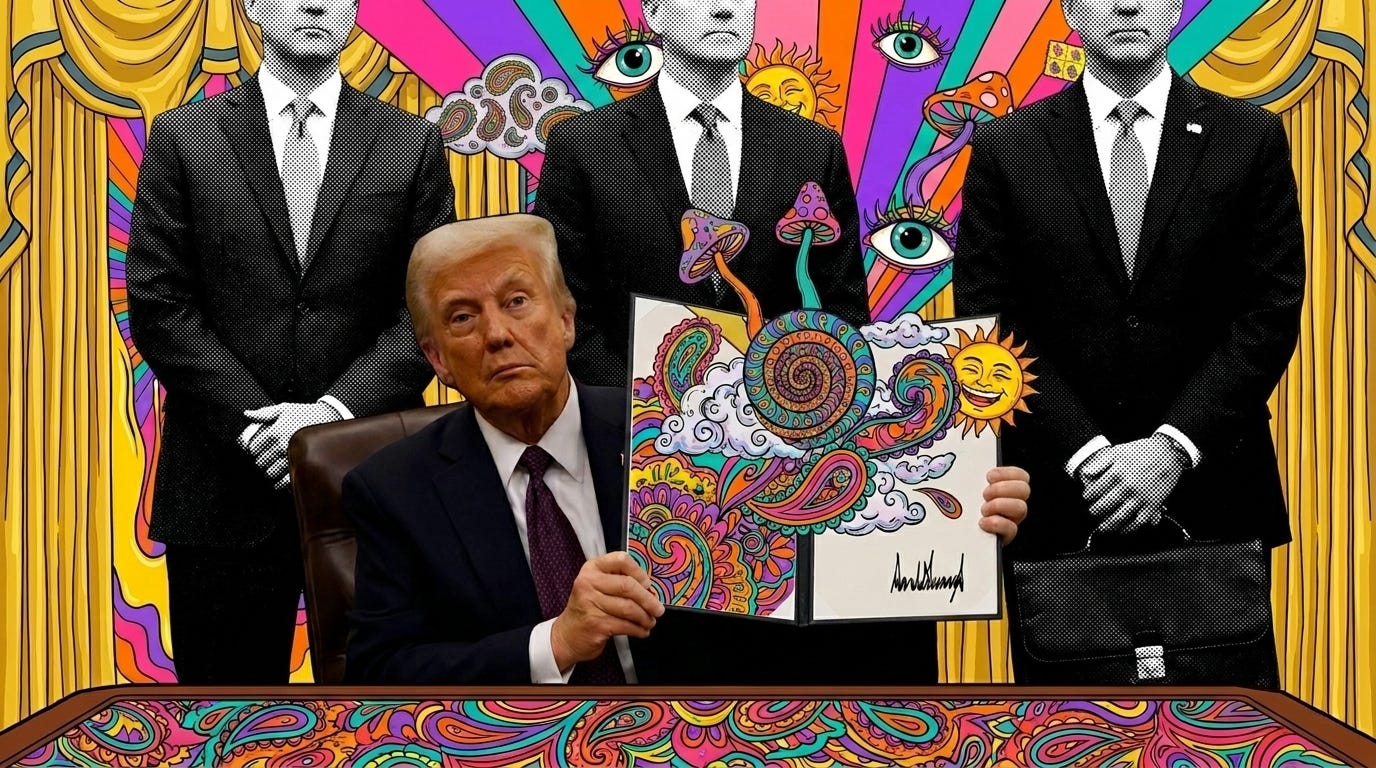
On April 18, the President signed an executive order fast-tracking federal review of psychedelic medicines for serious mental illness. By Monday morning, shares of one publicly traded psychedelic drug company had jumped more than 50% in a single trading day.
The Executive order is narrower than the headlines suggest. It directs the Food and Drug Administration to fast-track review for psychedelic compounds with breakthrough therapy designation, opens a Right-to-Try pathway for the terminally ill, and routes $50 million through ARPA-H to match state research programs. It is a meaningful step. It deserves a measure of celebration. And it also deserves a closer look, for it is difficult to trust a government that has normalized lying to such an extent that the public has lost trust and does not know what to believe.
For the past three years, I have been writing a book about what could go wrong at exactly this moment. It is called The Adverse Effects and Therapeutic Potential of Psychedelic Medicines (Park Street Press), and it comes out on May 5.

The title has two halves for a reason. The therapeutic potential and the adverse effects belong together. We cannot lose sight of one when we focus on the other.
What I want to share with you today is what I am watching as the book nears publication.
What I am hearing this week
The cheers in the field are loud. Veterans groups, who have been the most effective advocates for ibogaine research, are calling this a turning point. Biotech executives are calling it validation. Researchers I respect are calling it a threshold moment.
In addition to the cheers there are other voices, and these are the ones I want to draw your attention to.
Rick Doblin, who founded MAPS and has spent forty years advocating for psychedelic medicine legitimacy, immediately reminded the field that the results we have been celebrating came from drug access combined with psychotherapy access.
We are closer than ever to psychedelics becoming legal medicines again, but what’s emerging looks different from what I spent 40 years fighting for. My biggest concern now is no longer whether these therapies will be approved, but what they will look like when they arrive, and who will be able to access them.
Companies are increasingly minimizing or eliminating the therapeutic component entirely, treating the drug as the product and everything around it as a cost to be cut. If those models set the standard for what psychedelic therapy means, people seeking healing will receive a fraction of the long-term benefits these treatments can offer.
— Rick Doblin, Ph.D., Founder & President of MAPS
Drug access alone is a different model. Lineage holders are warning that a rush to FDA-approved pharmaceuticals could strip these medicines of the contexts that made them medicines in the first place. Researchers are cautioning against politicized science driven by influencer advocacy and veteran testimony, against the slow, careful work of safety and efficacy data being skipped. The field’s critics are pointing at industry connections in the funded research and asking who benefits.
The community is unanimous on very little. We should be honest about that.
When the money arrives
I have lived through every phase of this story since 1965. What I am watching now is the money arriving. The medicines have been here for thousands of years. The money is what is new.
Some of the companies whose stocks jumped 20 to 50 percent on Monday morning are doing real science. What concerns me, as someone who has watched a great many medical revolutions arrive and depart, is the pattern that surrounds the money. Several of the companies at the front of the line have already begun stripping psychotherapy out of their psychedelic protocols. Therapy is expensive. Therapy is hard to scale. Therapy is impossible to patent. A pill is cheaper to make, easier to deliver, simpler to sell.
The outcomes that brought us to this moment came from a trained guide, an integration practice, and a setting that supported the work. A pill alone has never produced them.
I am old enough to remember when Merck was the most admired company in America. Fortune gave them that title for seven straight years. Their founder said in 1950 that medicine was for the people, not for the profits, and for most of a century the company lived by that line. Then came Vioxx. Doctors wrote 107 million prescriptions for the drug between 1999 and 2004. When the internal data showed it raised the risk of heart attack, the company did not tell doctors. When academic researchers raised concerns, their universities were pressured to quiet them.
A century of trust was destroyed in five years.
The pattern is the risk.
A reckoning for the field
For sixty years, the people who advocated for these medicines did so with little, if any, institutional support, with minimal funding, often at risk to their careers and sometimes their very freedom. I include myself among them. We were a small community holding a small flame. I wrote about many of these courageous scientists in my book Psychedelic Medicine.
A lot has changed since the 2010s when I wrote that book and conducted those interviews. At the time, it was actually possible to speak to every single researcher in the United States who had been allowed to do clinical trials with psychedelics.
That community has grown. And it is about to be very large, very well-funded, and very visible. The work of the next five years will look very different from the work of the last fifty. The people who arrive in this field over the next decade will outnumber the people who built it.
Here is what I think the psychedelic community has to do, now that the tide is turning.
Let us be honest about the unwanted complications of these medicines, including the prolonged perceptual disturbances, the existential crises, the somatic challenges, and the abuses of patient trust by individual practitioners. The information will surface anyway. If we are not the ones telling the truth about it, someone less careful will be.
Let us set the standard for transparency that we have spent decades accusing other industries of failing to set. Let’s hold ourselves to the standard we have asked Big Pharma to meet.
And let us refuse to look away when bad actors in our own field exploit vulnerable people. There are practitioners operating right now who attach prestigious academic credentials to mass emails, charge a fee through PayPal, and promise to heal cancer, depression, addiction, and trauma in a weekend retreat. People have died at those retreats. I write about one of them, by name, in chapter 12 of my book. Every field has people like this. Ours is no exception. The next five years will sort the field into people who confront that and people who do not.
Why I wrote this book
I wrote Adverse Effects and Therapeutic Potential to contribute to how we, as a community, handle a moment of unprecedented attention and capital.
Will psychedelic medicines be another drug dispensed in 15-minute sessions with psychiatrists, or will they be used properly as facilitators of psychotherapy?
A few early readers of my book have written kind words. From Dr. Dennis McKenna, ethnopharmacologist and author of The Brotherhood of the Screaming Abyss:
Dr. Richard Louis Miller is a true elder and wisdom keeper of the psychedelic community, and his credentials come honestly, through hard-won experience. In this book, he continues his role as an educator by sharing his knowledge of both the perils and the promise of psychedelic substances. The reader will find valuable advice on how to avoid pitfalls while realizing the maximum benefits from the thoughtful and safe use of these remarkable medicines.
And from Dr. Robin Carhart-Harris, neuroscientist at the University of California, San Francisco:
Putting forth the adverse effects of these substances in readable form contributes to their understanding and separates psychedelic scientists from those who would cover over, or even hide, negative effects of pharmaceuticals.
If any of this speaks to you, you can pre-order the book here.
In the meantime, if you want to, celebrate the executive order. Celebrating is always fun. And keep your eyes, heads and hearts open as big money changes the psychedelic medicine landscape.
Golden Light,
Dr. Richard Louis Miller
One more thing this week
I just sat down with Sam Believ, who runs an ayahuasca retreat called LaWayra in Colombia. Sam and his team have served close to three thousand guests. They have never sent one to a hospital. He also call out the commercial shortcut pattern as a kind of “bastardization” of psychedelic medicine, and walks through how we did it to tobacco, cacao, and coca – robbing these substances of their healing potential through commodification.
A note on working together
For those who feel drawn to working together more directly, I offer a limited number of one-on-one sessions.
These are not traditional therapy sessions. They are quiet, practical conversations focused on calming the mind, easing anxiety, and working with simple tools that support steadiness in daily life.
We move at a thoughtful pace. We work with what’s present. We focus on what helps.
My Other Books:

Master Your Mind: Practical Tools to Calm Anxiety, Silence Your Inner Critic and Stop Overthinking
Freeing Sexuality: Psychologists, Consent Teachers, Polyamory Experts, and Sex Workers Speak Out
Psychedelic Wisdom: The Astonishing Rewards of Mind-Altering Substances
Psychedelic Medicine: The Healing Powers of LSD, MDMA, Psilocybin, and Ayahuasca
Integral Psychedelic Therapy (co-edited with Jason A. Butler & Genesee Herzberg)