

Dear Friends,
I read an article recently about young men who order a pizza, stay home, watch pornography, and masturbate instead of going out and finding a date. It is easier. However, DIY is feeding an epidemic of isolation, alienation, and loneliness.
I put that observation to Diana Richardson, a Swiss expert on human sexuality with over fifty years of experience.
In the early twentieth century, fewer than ten percent of women had sex before marriage — ninety percent of brides were virgins. Over the past hundred years, those numbers have reversed. We fought hard for that freedom in the counterculture revolution of the 1960s, which I’m delighted to say I was part of.
But now, by several measures, young people are having less sex than any generation in memory. Diana’s response surprised me: she said the amount of sex was never really the problem.
“It’s really the how of sex,” she told me.
Her work argues that most of what we call sex is mechanical and goal-driven, aimed at a finish line, and that racing for the finish line is exactly what disconnects people from their own bodies and from each other.
Diana’s own path started at thirty-two, when she began asking blunt questions about her own body and writing down what she found. Fifty years and eight books later — Slow Sex, Tantric Sex for Men, Tantric Orgasm for Women among them — more than 15,000 couples have gone through her seven-day Making Love Retreat in Europe. She has just finished building a self-paced online version — find her work at rekindle.love, rekindletantra.com, and loveforcouples.com, and follow her at facebook.com/learnlivinglove.
Please listen to our conversation. Below it, a small practice built on the idea Diana kept returning to: slow down, and the rest follows.
Today’s Practice: The Five-Minute Slow Down
A simple thing to take with you from this week’s conversation.
Next time you’re with your partner, take five minutes with no goal attached to them — nothing you’re trying to reach. Keep your eyes open. Let your jaw, shoulders, and hands soften instead of tensing toward something. Breathe normally, not held.
That’s it. Diana’s whole body of work comes down to this: the moment you stop racing toward a finish line, you start noticing what’s actually happening in the room.
If you try it, write back and tell me what you noticed.
Golden light,
Dr. Richard Louis Miller
Resources mentioned
Diana Richardson, Tantric Sex for Lovers (Destiny Books) — the boxed collection of Slow Sex, Tantric Sex for Men, Tantric Orgasm for Women
Diana Richardson, The Heart of Tantric Sex (John Hunt Publishing/O Books, 2003)
rekindle.love — Diana’s site, books, and the self-paced online Making Love Retreat
Rekindle Intimacy: The Living Love Symposium — 4-day online gathering Diana is hosting Sept 17–20, 2026
Diana Richardson’s first RLM appearance, “The Power of Slow Sex” (aired March 2022)
A note on working together
I offer a small number of one-on-one sessions for those who want to work with me directly.
This is not traditional therapy. You bring whatever is troubling you, and we practice the simple tools I have used with patients for six decades — ways of quieting the mind and easing anxiety that you can carry into daily life.
We go at your pace, and we work on what helps.
My New Book
The Adverse Effects and Therapeutic Potential of Psychedelic Medicines was recently reviewed by Samuel Bendeck Sotillos in the Journal of Psychedelic Studies. I was honored by it. Read the review here.

A few words from the front of the book:
Dr. Richard Louis Miller is a true elder and wisdom keeper of the psychedelic community, and his credentials come honestly, through hard-won experience. In this book, he continues his role as an educator by sharing his knowledge of both the perils and the promise of psychedelic substances. The reader will find valuable advice on how to avoid pitfalls while realizing the maximum benefits from the thoughtful and safe use of these remarkable medicines.
— Dr. Dennis McKenna, ethnopharmacologist and author of The Brotherhood of the Screaming Abyss
Putting forth the adverse effects of these substances in readable form contributes to their understanding and separates psychedelic scientists from those who would cover over, or even hide, negative effects of pharmaceuticals.
— Dr. Robin Carhart-Harris, neuroscientist at the University of California, San Francisco
It’s the fifth book in my series on psychedelic medicine. You can find it on Amazon.
My Other Books
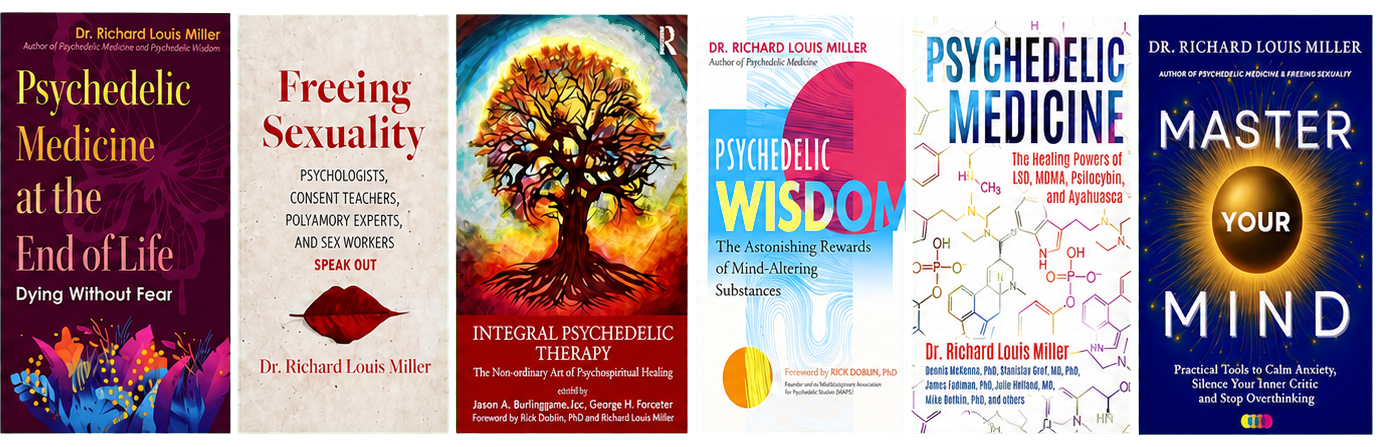
Freeing Sexuality: Psychologists, Consent Teachers, Polyamory Experts, and Sex Workers Speak Out
Integral Psychedelic Therapy (co-edited with Jason A. Butler & Genesee Herzberg)
Psychedelic Wisdom: The Astonishing Rewards of Mind-Altering Substances
Psychedelic Medicine: The Healing Powers of LSD, MDMA, Psilocybin, and Ayahuasca
Master Your Mind: Practical Tools to Calm Anxiety, Silence Your Inner Critic and Stop Overthinking


