

Dear Friends,
Dr. Bruce Lipton was with me here on Mind Body Health and Politics years ago, before many of you had ever heard the word “epigenetics.” Now it’s almost a household word. Bruce is here again, and this time around we spent most of the hour on a single idea: ninety-five percent of what runs your life was not written by you.
Bruce says the brain is a computer, and it arrives with no programs installed. From about three months before you’re born through roughly age seven, you’re recording everything you experience—your parents, your community, what a body is supposed to do—without the conscious mind in the room to argue with any of it. By his estimate, those recordings run about ninety-five percent of your adult life. The part of you that thinks it’s deciding things is mostly watching a program play.
I’ve been telling people for years that the mind wants to be the boss, and that until you learn to tell it otherwise, it will act like one. Bruce provided me with a mechanism underneath that.
One of the programs installed in us very early is what old is supposed to look like. As a child, watch enough people fall apart as they age, as if on a schedule, and some part of you signs up to fall apart on schedule too.
“When I look at my eyes, I don’t see an age gauge. I’m looking at the same eyes I had as a kid.” Bruce Lipton
Acting your age is dangerous.
The bigger program Bruce wants rewritten isn’t personal—it’s the one Darwin gave us. His forthcoming book, Beyond Darwin, argues that “survival of the fittest” was never the whole story, and that cooperation, not survivalist competition, is what actually carried us here.
I invite you to join us for the entire stimulating conversation. Below, a small practice for finding one of your own programs.
Today’s Practice: Do One Thing Your Age Isn’t Supposed to Do
A simple thing to take with you from this week’s conversation.
Pick one activity you’ve quietly written off because of your age—a flight of stairs, a dance, a phone call you’ve started “letting the kids handle.”
Do a scaled-down version of it this week. Not the reckless version, but the honest one.
Notice, afterward, whether the limit was in your body or in the program. Most of the time you’ll find it was the program.
Write back and tell me what you picked.
Golden light,
Dr. Richard Louis Miller
Resources mentioned
Bruce H. Lipton, The Biology of Belief: Unleashing the Power of Consciousness, Matter & Miracles (Hay House, 10th Anniversary Edition)
Bruce H. Lipton, PhD & Patricia King, Beyond Darwin: How Epigenetics, Quantum Science, and Cooperation Shape Humanity’s Future (BenBella Books, August 2026)
I offer a small number of one-on-one sessions for those who want to work with me directly.
This is not traditional therapy. You bring whatever is troubling you, and we practice the simple tools I have used with patients for six decades — ways of quieting the mind and easing anxiety that you can carry into daily life.
We go at your pace, and we work on what helps.
My New Book
The Adverse Effects and Therapeutic Potential of Psychedelic Medicines was recently reviewed by Samuel Bendeck Sotillos in the Journal of Psychedelic Studies. I was honored by it. Read the review here.

A few words from the front of the book:
Dr. Richard Louis Miller is a true elder and wisdom keeper of the psychedelic community, and his credentials come honestly, through hard-won experience. In this book, he continues his role as an educator by sharing his knowledge of both the perils and the promise of psychedelic substances. The reader will find valuable advice on how to avoid pitfalls while realizing the maximum benefits from the thoughtful and safe use of these remarkable medicines.
— Dr. Dennis McKenna, ethnopharmacologist and author of The Brotherhood of the Screaming Abyss
Putting forth the adverse effects of these substances in readable form contributes to their understanding and separates psychedelic scientists from those who would cover over, or even hide, negative effects of pharmaceuticals.
— Dr. Robin Carhart-Harris, neuroscientist at the University of California, San Francisco
It’s the fifth book in my series on psychedelic medicine. You can find it on Amazon.
My Other Books
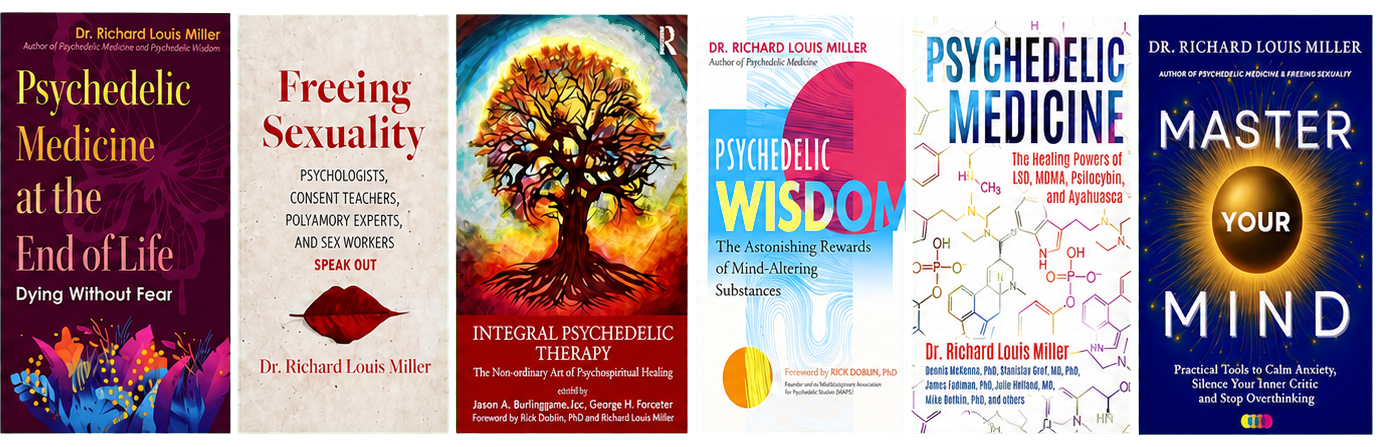
Freeing Sexuality: Psychologists, Consent Teachers, Polyamory Experts, and Sex Workers Speak Out
Integral Psychedelic Therapy (co-edited with Jason A. Butler & Genesee Herzberg)
Psychedelic Wisdom: The Astonishing Rewards of Mind-Altering Substances
Psychedelic Medicine: The Healing Powers of LSD, MDMA, Psilocybin, and Ayahuasca
Master Your Mind: Practical Tools to Calm Anxiety, Silence Your Inner Critic and Stop Overthinking


